
Stop Setting SMART Goals
The destination was never the point. Here’s what actually moves you forward.

You’ve been taught to set goals wrong.
Not because the framework is stupid — SMART goals work fine for quarterly targets and project timelines. But as a system for personal transformation, for becoming someone different, for actually executing the big ideas you’ve been sitting on? They quietly set you up to fail.
Here’s why.
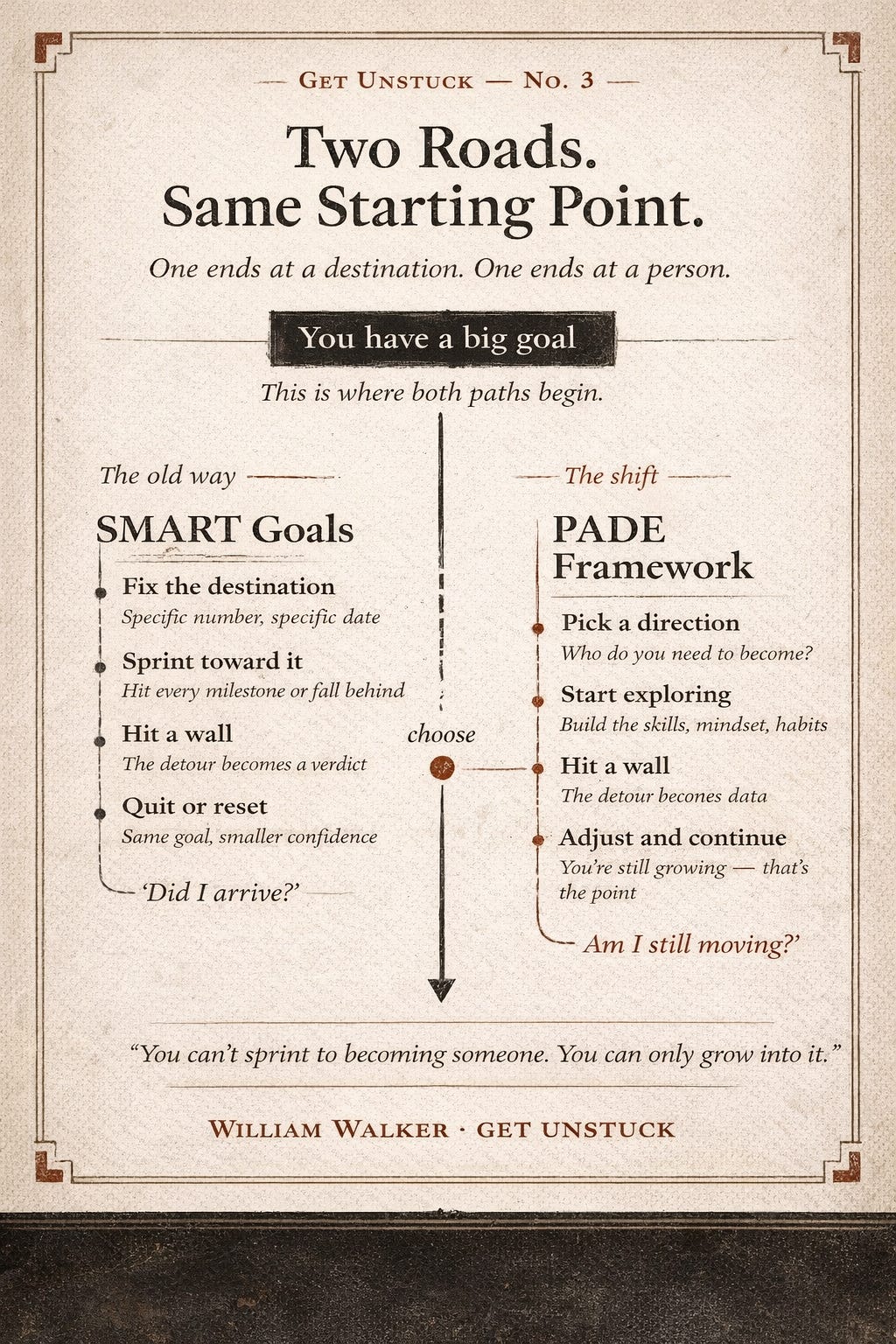
SMART goals anchor everything to the outcome. Specific, measurable, time-bound — the whole structure points you toward a finish line and asks you to run toward it. Which sounds reasonable until you hit the first wall, which you will, and suddenly the question becomes: am I failing at the goal, or am I failing as a person?
That distinction collapses faster than you’d think.
When your identity gets wrapped around a destination, every detour feels like evidence that you don’t have what it takes. Every missed deadline isn’t a scheduling problem — it’s a character verdict. And the moment that happens, most people stop. Not because the goal was wrong, but because the framework made failure feel personal.
The goal isn’t the point. The person you become chasing it is.
This is the core shift that changes everything.
What if instead of orienting around what you want to achieve, you oriented around who you need to become to sustain it? Not the launch — the founder. Not the published book — the writer who shows up every day. Not the revenue number — the person with the discipline, the relationships, and the mindset to generate it.
That’s the PADE framework. Pick A Direction and Explore.
PADE sounds almost too simple. Choose a direction. Start moving. Stay curious about what you find. But underneath that simplicity is a fundamentally different relationship with progress.
Here’s how it works in practice.
Take a SMART goal: I want to build an online course that generates $25,000 a year by December.
A PADE thinker looks at that goal and asks different questions entirely:
What does the person who runs that business actually think about every day? What do they believe about their own expertise? How do they handle the week when nobody buys anything? What skills do they have that I don’t yet? What do they know about their audience that I’m still guessing at?
Now you have something to work with. Not a deadline — a description. Not a finish line — a direction. You start building toward that person instead of toward that number, and something strange happens: the number tends to follow anyway.
You can’t sprint to becoming someone. You can only grow into it.
There’s a practical reason this matters beyond motivation.
SMART goals create a binary. You hit it or you don’t. The year ends and you either made $25k or you didn’t, and if you didn’t, what do you do with that? Most people set the same goal again, or a slightly smaller one, or they abandon the category entirely and tell themselves it wasn’t for them.
PADE doesn’t have a binary. Because you’re asking ‘who am I becoming,’ there’s always a real answer. You’re always somewhere on the path. The question is never did you arrive — it’s are you still moving in the right direction.
That’s not a consolation prize. That’s a more accurate relationship with how change actually works.
Nobody becomes a great writer in a year. Nobody builds real expertise in a quarter. Nobody develops the emotional resilience, the professional relationships, the creative instincts of the person they want to be on a twelve-month timeline. That stuff compounds over years. And the only way to compound it is to stay in motion — which means you need a framework that rewards motion, not just arrival.
Here’s where to start.
Take the big thing you’re working toward — the business, the creative project, the career shift, whatever it is. Don’t write down the outcome you want. Instead write down this:
What kind of person sustains this five years from now? Describe them. How do they think? What have they learned? What do they believe about themselves and their work that they didn’t believe before?
That description is your direction. Not a deadline. A person.
Now ask: what’s one quality, skill, or belief on that list that I can start developing today? Not finish — start. Just one.
That’s your next step. Not the launch plan. Not the revenue model. Not the audience strategy. Just the one thing that moves you a degree closer to the person who can do all of that sustainably.
Pick a direction. Start moving. See what you find.
The goal will take care of itself.
Next in the Get Unstuck series: Write Your Eulogy Before You Die — the exercise that makes every other decision easier.
That One Friend · William Walker · Get Unstuck No. 3
This series is not a replacement for therapy. These tools work best alongside professional support.
this is quite interesting for me as I am building my company. And you are correct, a SMART goal only describes the desired outcome, but not how to get there. Yes, it should be "attainabale", but that does not describe the how. "Am I still moving", instead of "Did I arrive" is a brilliant rewiring of the thinking.
"What kind of person sustains this five years from now? Describe them. How do they think? What have they learned? What do they believe about themselves and their work that they didn’t believe before?"
Love this!