
Cast Your Spell
The daily practice that rewires the loop — and why affirmations usually fail.

You’ve probably tried affirmations before.
You stood in front of the mirror. You said the words. I am confident. I am worthy. I am capable of great things. And then you felt slightly ridiculous, went about your day, and nothing changed.
The reason it didn’t work isn’t that affirmations are useless. It’s because the version you were doing was missing something — and without that missing piece, you’re essentially just arguing with your own nervous system. Which is a fight you will lose every time.
Here’s what most affirmation advice gets wrong.
It tells you to say things you don’t yet believe as if you already believe them. I am a bestselling author. I am financially free. I am fearless.
Your brain is not stupid. It has evidence. It has receipts. And when you tell it something that contradicts all of that evidence, it doesn’t update — it pushes back. The inner voice that says who are you kidding isn’t sabotage. It’s your mind doing exactly what it was built to do: protect the model it has of reality from statements that don’t match.
So the affirmation fires, the resistance fires louder, and you end up feeling worse than before you started.
You can’t override the loop with a lie. You have to outgrow it with a truth.
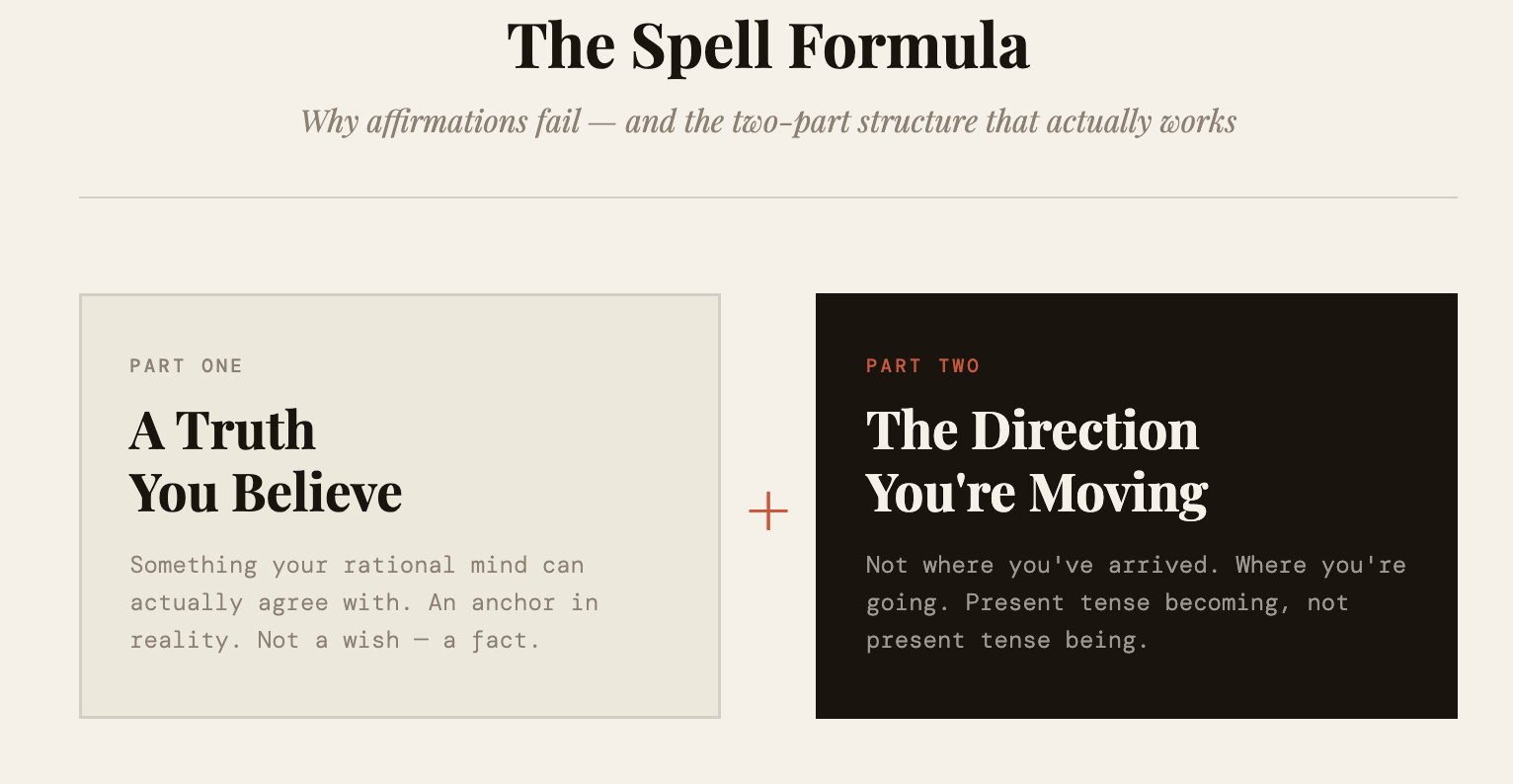
The difference between an affirmation and what I’m calling a spell is this: a spell is rooted in something you actually believe.
It starts with a true statement about yourself or the world. Something your rational mind can agree with. And then it layers in the direction — the identity you’re growing toward — in a way that doesn’t require you to pretend you’re already there.
The template is simple:
[Something true about yourself or the world], I am [the direction you’re growing toward].
Not I am fearless. Try: The world responds to people who act despite their fear. I am learning to act.
Not I am a successful writer. Try: Ideas worth sharing exist inside me. I am becoming someone who shares them.
Not I am confident. Try: Confidence is built through action, not granted before it. I am taking the actions.
Feel the difference? The first half anchors in reality. The second half points toward growth. Your brain doesn’t have to reject it because you’re not claiming to already be there — you’re claiming to be moving.
Now here’s how to build yours.
Go back to the eulogy you wrote in the last piece. Pull out the qualities — the character traits, the ways of being — of the person in that eulogy. Pick two or three that feel most urgent. The ones where the gap between now and then feels most alive.
For each one, write a spell using the template. True statement plus direction. Keep it short enough to remember. Test it by reading it out loud — if it makes you wince because it feels like a lie, revise the first half until it lands as honest.
You want something that makes you feel a little uncomfortable but not dishonest. Uncomfortable because you’re not fully there yet. Not dishonest because you’re not pretending you are.
The spell isn’t who you are. It’s who you’re in the process of becoming.
Once you have your spells, the practice is simple: don’t let them live in a document you never open.
Make them impossible to ignore. Phone screensaver. Index card on your desk. Sticky note on the bathroom mirror. The first line of your journal every morning. The point isn’t repetition for its own sake — it’s keeping the direction visible when the loop tries to reroute you.
Because it will. The loop doesn’t give up just because you named it. It will fire again when you’re about to do the thing. And in that moment, the spell is what you reach for — not to silence the loop, but to remind yourself of who’s in charge of the next decision.
The loop says nobody is going to care about this.
The spell says: ideas worth sharing exist inside me. I am becoming someone who shares them.
And then you hit publish anyway.
That’s the whole system.
Your thoughts aren’t entirely yours — most of them were handed to you before you had the awareness to question them. Some of them are protective loops running code written for a much younger version of you. The framework you’ve been given for goals has been pointing you at destinations instead of people. You have a future self you’re growing toward, and they have qualities you can start developing today. And every day you can say something true about yourself and the direction you’re moving that keeps that future self visible.
None of this is a straight line. You’ll run the loop sometimes. You’ll lose the thread. You’ll go weeks without touching the spells and feel yourself drifting back to old patterns.
That’s fine. The practice isn’t perfection — it’s return. You come back to it. You reread the eulogy. You revise the spells as you grow. You pick the direction again.
That’s not failure. That’s what it actually looks like to build a life on purpose.
You’re not stuck because you’re broken.
You’re stuck because nobody gave you the right tools.
Now you have them.
This was really good. The topic (affirmations) is so relevant to me, and I appreciated the tips about what practice is more useful than affirmations. LOVE the title. This piece would have been even better if it hadn't been written by an LLM. Just my opinion. 😏